OSPF Route Summarization
ccnp-routing
Shows why OSPF allows summarization only between areas and how to configure area range on ABRs, with routing tables before and after.
- Only on ABR and ASBR
- In one area, all routers have to have the same LSDB otherwise they cannot run the SPF algorithm
- So OSPF does NOT allow summarization within an area (intra-area)
- But it allows summarization between different areas (inter area)
Configuration
We want to advertise 10.10.1.0/25 and 10.10.1.128/25 as a 10.10.1.0/24 to R2:
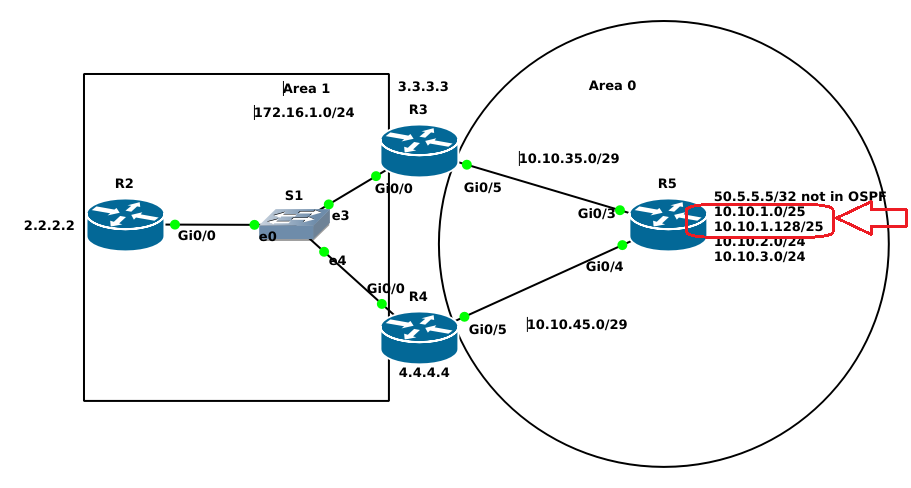
R2#show ip route ospf
Gateway of last resort is not set

      10.0.0.0/8 is variably subnetted, 6 subnets, 2 masks
O IA     10.10.1.1/32 [110/3] via 172.16.1.4, 00:35:20, GigabitEthernet0/0
                      [110/3] via 172.16.1.3, 00:16:04, GigabitEthernet0/0
O IA     10.10.1.129/32 [110/3] via 172.16.1.4, 00:35:20, GigabitEthernet0/0
                        [110/3] via 172.16.1.3, 00:16:04, GigabitEthernet0/0
O IA     10.10.2.1/32 [110/3] via 172.16.1.4, 00:35:20, GigabitEthernet0/0
                      [110/3] via 172.16.1.3, 00:16:04, GigabitEthernet0/0
O IA     10.10.3.1/32 [110/3] via 172.16.1.4, 00:35:20, GigabitEthernet0/0
                      [110/3] via 172.16.1.3, 00:16:04, GigabitEthernet0/0
O IA     10.10.35.0/29 [110/2] via 172.16.1.3, 00:16:04, GigabitEthernet0/0
O IA     10.10.45.0/29 [110/2] via 172.16.1.4, 00:35:20, GigabitEthernet0/0
R3
R3(config)#router ospf 1
R3(config-router)#area 0 range 10.10.1.0 255.255.255.0
Let us see the routing table of R2 after summarization on R3
R2#show ip route ospf
Gateway of last resort is not set

      10.0.0.0/8 is variably subnetted, 7 subnets, 3 masks
O IA     10.10.1.0/24 [110/3] via 172.16.1.3, 00:00:05, GigabitEthernet0/0
O IA     10.10.1.1/32 [110/3] via 172.16.1.4, 00:36:11, GigabitEthernet0/0
O IA     10.10.1.129/32 [110/3] via 172.16.1.4, 00:36:11, GigabitEthernet0/0
O IA     10.10.2.1/32 [110/3] via 172.16.1.4, 00:36:11, GigabitEthernet0/0
                      [110/3] via 172.16.1.3, 00:16:55, GigabitEthernet0/0
O IA     10.10.3.1/32 [110/3] via 172.16.1.4, 00:36:11, GigabitEthernet0/0
                      [110/3] via 172.16.1.3, 00:16:55, GigabitEthernet0/0
O IA     10.10.35.0/29 [110/2] via 172.16.1.3, 00:16:55, GigabitEthernet0/0
O IA     10.10.45.0/29 [110/2] via 172.16.1.4, 00:36:11, GigabitEthernet0/0
Now let us do the summarization on R4 as well.
R4R4(config)#router ospf 1 R4(config-router)#area 0 range 10.10.1.0 255.255.255.0Let us see the routing table of R2 after summarization on both R3 and R4:
R2#show ip route ospf
Gateway of last resort is not set

      10.0.0.0/8 is variably subnetted, 5 subnets, 3 masks
O IA     10.10.1.0/24 [110/3] via 172.16.1.4, 00:10:28, GigabitEthernet0/0
                      [110/3] via 172.16.1.3, 00:11:50, GigabitEthernet0/0
O IA     10.10.2.1/32 [110/3] via 172.16.1.4, 00:47:56, GigabitEthernet0/0
                      [110/3] via 172.16.1.3, 00:28:40, GigabitEthernet0/0
O IA     10.10.3.1/32 [110/3] via 172.16.1.4, 00:47:56, GigabitEthernet0/0
                      [110/3] via 172.16.1.3, 00:28:40, GigabitEthernet0/0
O IA     10.10.35.0/29 [110/2] via 172.16.1.3, 00:28:40, GigabitEthernet0/0
O IA     10.10.45.0/29 [110/2] via 172.16.1.4, 00:47:56, GigabitEthernet0/0
- Note:
- On ABR We used
area X range IP MASKunder the router configuration - On ASBR we use
summary-address IP MASKunder the router configuration
- On ABR We used
One more thing.
Let us see the routing table of R3 which was one of the ABRs we did summarization on:R3#show ip route ospf
Gateway of last resort is not set
10.0.0.0/8 is variably subnetted, 8 subnets, 3 masks
O 10.10.1.0/24 is a summary, 00:00:25, Null0
O 10.10.1.1/32 [110/2] via 10.10.35.5, 00:00:25, GigabitEthernet0/5
O 10.10.1.129/32 [110/2] via 10.10.35.5, 00:00:25, GigabitEthernet0/5
O 10.10.2.1/32 [110/2] via 10.10.35.5, 00:00:25, GigabitEthernet0/5
O 10.10.3.1/32 [110/2] via 10.10.35.5, 00:00:25, GigabitEthernet0/5
O 10.10.45.0/29 [110/2] via 10.10.35.5, 00:00:25, GigabitEthernet0/5
The ABR that creates the summary route will create a null0 interface to prevent loops (if a loop happened, it would continue until the IP TTL expires). We know that we have more specific routes in the routing tables for a couple of 10.10.x.x networks. However, when a packet is received destined to 10.10.1.0 but there is no destination, the packet is sent to the blackhole null0 interface.