Dynamic Multipoint VPN (DMVPN)
ccnp-routing
Introduces DMVPN components such as mGRE, NHRP, and IPsec, how spokes register with the hub, and how phases 1, 2, and 3 differ in spoke traffic.
- A point-to-multipoint overlay VPN tunneling technology
- Dynamic and scalable way to build GRE over IPsec site-to-site tunnels
- Spoke to spoke traffic routes over dynamic on-demand tunnels
- Simple configuration management compared to MPLS L2 and L3 VPNs
- Provisioning of new sites will be very straightforward and easy
- Supports transport of multiple protocols
- IPv4 & IPv6, unicast & multicast, static & dynamic routing
- Uses any IP transport:
- Any Internet connectivity: T1, DSL, Cable, Ethernet, etc.
- Support arbitrary number of ISPs
- Supports going through NAT
- Scalable encryption
- Spoke-to-spoke tunnels only form as needed
- MPLS L3VPN vs DMVPN
- MPLS L3 VPN adds additional routing complexity
- You have to pay the ISP to provide support of IPv6 in MPLS L3 VPN
- Inter-provider MPLS L3VPN is difficult
- In MPLS L3VPN, we have separate circuits for VPN traffic and for Internet access
- MPLS L2VPN with VPLS vs DMVPN
- Limited connectivity options for example Ethernet only solution
- Inter-provider MPLS L2VPN is difficult
- Separate circuit needed for Internet access
- DMVPN Components
- Can be broken down into two major components
- Traffic routing
- mGRE
- Next Hop Resolution Protocol (NHRP)
- Routing IGP, BGP, etc.
- Traffic Encryption
- IPsec
- Traffic routing
- Can be broken down into two major components
How DMVPN Works
- Two main components
- DMVPN Hub/ NHRP Server
- DMVPN Spokes / NHRP Clients
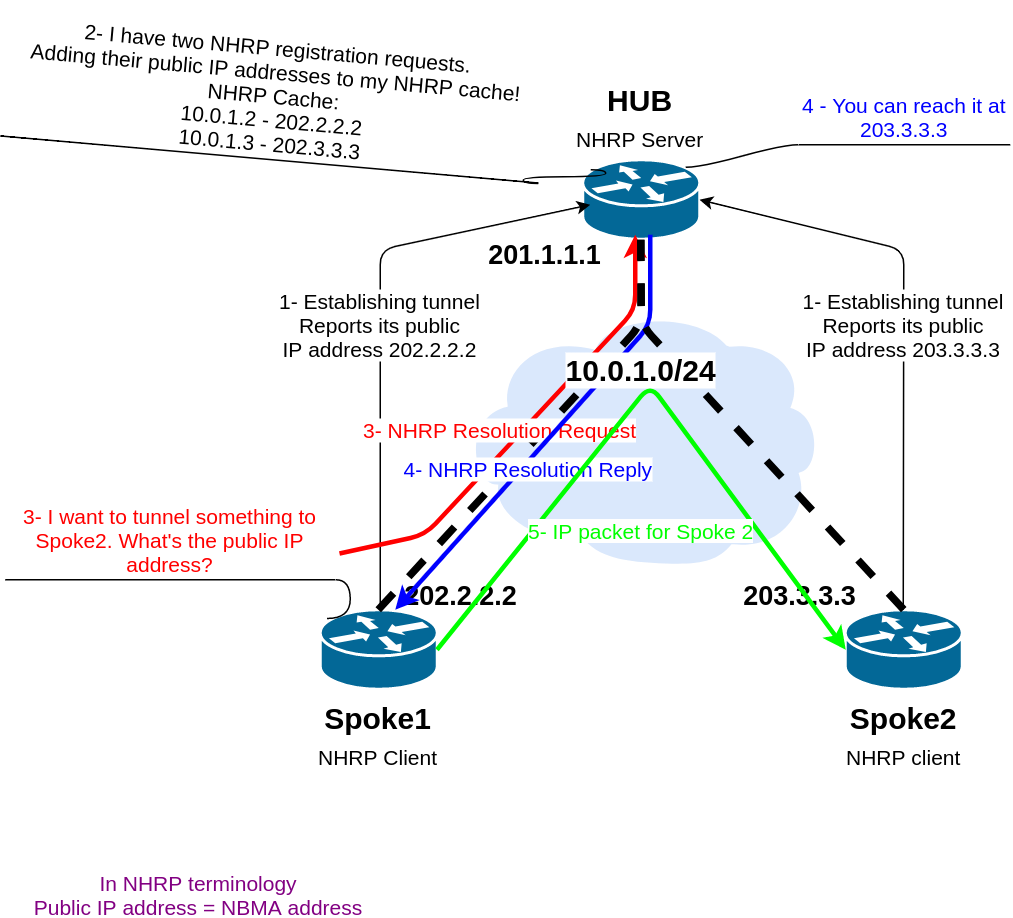
- Spoke/Client register with Hub/Server
- Spokes manually specify Hub’s address
- Hub dynamically learns Spokes’ VPN address and NBMA address
- Sent via NHRP request (NHRP is like Frame Relay or ATM inverse ARP; instead of mapping L2 to L3 information, we are now mapping a tunnel IP address to an NBMA address.)
- Spokes establish tunnel to hub
- Used to exchange IGP routing information
- Spokes know routes to other spokes somehow: could be through static route, IGP, or BGP
- These routes learned via the tunnel to the hub
- Once the spoke-to-spoke tunnel is formed, hub is only used for control plane exchange
- It is possible you have multiple NHRP Servers, multiple levels of tunnels.
- We will use a simple design, a single DMVPN with a single hub
DMVPN versions (Phases)
- DMVPN Phase 1
- All spokes use regular point-to-point GRE tunnel interfaces
- No direct spoke-to-spoke communication
- DMVPN Phase 2
- We have spoke-to-spoke tunneling
- Spoke routers should have a route to the other spoke
- Next-hop IP address of the route has to be the remote spoke
- DMVPN Phase 3
- Spoke router does not need to have specific route to the other spoke
- It does not matter what the next-hop IP address is
- Spoke1 sends the traffic directly to the hub. Hub sees that another spoke is destination. Hub then sends an NHRP redirect to both spokes.
- Then spokes send an NHRP resolution to retrieve the NBMA addresses, then spokes install a new entry in the routing table