Federated DDoS Detection
This M.A.Sc. project at ÉTS studies federated DDoS detection for service providers and their customers. It examines the value and limits of collaboration among participating networks. The English manuscript is being revised as dataset and deployment checks proceed. The proposed deployment now separates PoP training clients from software detection inside Internet border routers. The coherent private nine-chapter research draft now reconciles the current question map and component roles; full manuscript acceptance remains pending. Data feasibility and the final protocol remain open, and Chapter 1 awaits human review.
The work is supervised by Dr. Michel Kadoch. Sellier-inspired training remains an optional, bounded part of the project, with a dedicated chapter in the current structure. Its numerical treatment and the final evaluation protocol remain open; no training-time advantage or final detection result has been established.
Reference library Code and lab Private thesis workspace
Latest Update
November 18, 2026, controlled laboratory study executed and scored. The pre-registered study of design v2.1 has moved from design to results. Between 15 and 17 November the laboratory was built, independently audited and qualified, and two acquisition blocks were collected on 16 November. The packet conservation checks caught three generator faults, which were corrected, and physical conservation then held for all 164 attack episodes of the two blocks. The study was scored once, on 17 November, after independent audits of both analysis pipelines. The departures from the registered procedure are disclosed in the private draft.
On 17 November the research questions were revised with the supervisor. Packet sampling becomes the central question, federated transfer of an unseen attack type the second, the conservation checks a methods question, the specificity diagnostic an exploratory fourth, router cost a supporting fifth, and the conditional Sellier-inspired question becomes the sixth. The revised fifth question was measured in two parts with a stopping rule fixed before measurement. Training and exchange cost was measured in 40 trials, and the forwarding cost of metering and inference inside the emulated border router in 90 trials, with no failed trial in either part.
These results come from one laboratory in one virtual machine with generated benign traffic, so they describe a controlled evaluation and not a provider network. The private English draft now reports the methods and results; the researcher’s reading, native Word checks, French translation and the deposit remain open.
November 15, 2026, pre-registered controlled laboratory study, design v2.1. A new controlled laboratory study was designed and frozen before any build, traffic or data. It asks how packet sampling at a provider’s border routers changes what a router-side detector can see during flood-shaped DDoS attacks (RQ2), and how detection at a recipient point of presence changes when a second, contributing point of presence collaborates (RQ1 and RQ4). The study is pre-registered and separate from the earlier controlled track, which stopped at its pre-registered separability gate. That earlier result stays reported unchanged. No laboratory component of the new study has been built or started, and no traffic has been generated. Building the laboratory, qualifying it and acquiring data each need a separate release by the researcher.
The frozen design, topology, propositions and figure are published byte-identical to the frozen files, and their README states the status and limits of the design. The Lean project now holds 196 checked theorems in six modules, including 124 for the design propositions P1 to P12. The checker passes with the standard axioms only (propext, Classical.choice and Quot.sound). The formal-verification README states the limits of that check. For example, P4 is proved for an integer size only, P6 (d), P7 (b) and P9 are proved on finite sample spaces, P10 has its covariance identities only, and the keyed packet selector is treated as independent selection without proof. These are mathematical statements about the design, not measurements. The frozen design establishes what will be measured and how results will be judged. It does not establish detection performance, the effect of sampling, the benefit of collaboration or the behavior of a real provider network.
The next planned task is to write the offline laboratory build artifacts from the frozen design, using benign test fixtures only, and to have them independently audited. The researcher will then be asked for a go-ahead before the qualification and peak-load dry run. The laboratory virtual machine stays stopped until that release.
Earlier November 14, 2026, conditional source reconstruction and fit preparation. A completed reconstruction of previously used development evidence has passed an independent saved-output audit. Sampling and timeout views were replayed against retained ingress evidence, preserving the existing training and development assignments and common evaluation opportunities. Missing sampled observations remain coverage outcomes, not inferred classification decisions. This qualification is limited to the historical strict-conditioned cohort. It does not admit a wider source population, independent episodes, natural provider or customer roles, or untouched calibration and final-evaluation sets. New study fitting and scoring remain unrun.
Development training-controller checks and a separate statistical federated-method plan have also been audited. Actual-source fitting still depends on trusted readers, preserved training context and a bounded release. The methods retain different supervision and weighting, so these checks establish neither matched training work nor detection efficacy. The private English draft now records these boundaries; human reading and acceptance remain open.
Earlier November 14, 2026, ingress functional boundary and source screening. An independently audited finite native check exercised invented ingress packets, forwarding observations and flow-meter replay under the declared observation policy. The saved evidence also supports cleanup of the resources created for that check. This check included no learning or inference and does not establish detection efficacy, endpoint acceptance, deployment capacity, latency or source-data admission. A separate annotation-availability screen has completed; packet association, source eligibility, data-role assignment and fitting remain open gates.
The research plan retains four required questions and a conditional Sellier-inspired fifth question. The required work covers matched independent local, pooled-central and FedAvg learning with a separate statistical federated-system comparison; paired packet-sampling and timeout changes; router deployment with separate forwarding, inference and resource costs; and contributor-policy compatibility versus complementary DDoS behavior. The finite functional checks do not complete these evaluations.
Earlier November 14, 2026, development comparisons and separate native toy. A frozen FLNET development comparison has been executed. Reused observations, different transforms and optimizer choices limit causal and final-evaluation claims. A separate common two-counter flow-meter and training pilot retained an unfavorable fixed-decision finding. Its learned arms and count baseline produced no positive alerts. An earlier router-local component check exercised a source-trained model on synthetic probes inside a border-router process, together with forwarding, metering and collector-input parity. It establishes that finite component path, not detection efficacy or networked federated training. A distinct two-PoP native toy then exercised invented federated updates, model delivery and loading, and toy-model inference. Its benign toy records were flagged as positive. These false positives remain part of the record; the invented updates do not establish source-backed federated training. These observations establish neither a causal federated-learning advantage nor operational detection or scalability. Paired observation-policy experiments, workload and source-validity checks, human acceptance and French submission gates remain open. Reusable public packaging of the new implementations remains pending; earlier published source links retain their original scope.
November 12, 2026, frozen CSV scorer publication. The published score-only CSV interface provides export and loading interfaces for neural and AF-BKM-family model snapshots, owner-local TRAIN transform recovery and summary-only merging. Local and hosted checks of the integrated repository each discovered 328 unit tests, with 327 executed and one optional TShark test skipped. The engineering self-test and fabricated workflows passed. These checks use fabricated inputs; they do not establish detection accuracy, calibration or compatibility with live traffic.
The raw-data work supports only a narrow offline connection and counter reference from one inspected capture. Capture completeness, historical analyzer settings and independent attack episodes remain unresolved, so it has not been accepted as a controlled sampling/timeout benchmark. Final protocol selection, functional verification, and measured overlap and capacity checks remain open for the approved lab architecture and IP plan.
The original code commits and unchanged dependency lock remain recorded. This publication adds no acquired-data experiment and contains no fitted models, private execution receipts or raw records. Verification of reporting-threshold derivation and identity-linked decisions remains separate work.
Earlier November 12, 2026, loader checkpoint. The checked role-aware loader reproduced the development records and their existing training, validation and calibration assignments. The required suite passed 77 unit tests, its engineering self-test and synthetic workflow. Two bounded independent code critiques found no consequential implementation defect. A separate feature-value and multiplicity audit remains pending before fitting. No learned preprocessing, model fitting, calibration or model scoring was performed.
This preparation check does not establish training capacity or deployment performance. The candidate retains source observers and reserved-test boundaries; stored records do not establish independent customers or a common original sampling/timeout policy.
November 12, 2026. A reproducible development-role preparation now assigns training, validation and calibration roles to the acquired FLNET development records. One stored connection key has the same role at every observer. The candidate processed the verified development CSVs. The reserved test sources were excluded before opening or hashing, and no model was trained. The code passed 56 unit tests, its engineering self-test and the 225-record synthetic workflow, including poisoned reserved inputs.
The allocation remains provisional. Some observers have no attack records, class and collection date remain associated, and stored keys do not prove independent captures or customer identities. A bounded xAI critique found no blocking implementation defect for retaining this candidate. A second preparation reproduced the assignment digest and all role counts. This does not approve a scientific protocol. The private methods and results additions were saved and compiled; compilation does not resolve the older manuscript scope.
November 5, 2026. The private Sellier-inspired chapter now has explanatory figures and an indexed author-discussion guide with anchored Word comments. Source checks distinguish published statements, illustrative calculations and the proposed federated adaptation. A bounded xAI public-mathematics critique was checked against the primary texts; it did not review the private chapter. Author clarification and a numerical implementation remain pending. No new training or detection result is reported.
November 4, 2026, historical assessment. The earlier provider design uses provider-owned collection and scoring at points of presence (PoPs), with central coordination. These PoPs are candidate learning participants, whereas customers remain reporting and evaluation groups. No detector appliances are assumed on customer premises. The planned comparison covers independent local, permitted pooled-central and federated training. It keeps the same observation view, feature definitions and PoP inference placement. Pooled and federated training use the same permitted fitting evidence. Independent local training retains its local evidence. The comparison remains unrun. Three additional research papers and two RFCs have been acquired, and selected full-paper FlowSentry sections now replace the earlier abstract-only check. No EVE topology or scientific code was changed. Three bounded public-source xAI architecture critique calls are recorded; they did not receive or review the revised private Chapter 1.
November 3, 2026. The English opening and foundations now establish the background needed for the working study direction. DDoS, the learning task, model architecture, gradient training and federated coordination receive separate roles. The nine chapters and four working questions remain. Required source-data checks, the final learner and protocol, and the novelty assessment remain open. Chapter 1 awaits human review. No new training run, numerical QiML engine or final detection result is part of this milestone.
| Work completed | Scope and remaining limit |
|---|---|
| Manuscript foundations | The November 5 private English draft remains a historical manuscript checkpoint. The opening and foundations were revised, and the literature chapter records this targeted supplement. Human reading and final study decisions remain pending. The provider reference diagram is now placed in Chapter 1, beside an explicit explanation of the illustrative topology. Chapter 4 refers back to the same figure. This is a manuscript presentation update; it does not change the architecture or establish lab readiness. |
| Foundational sources | Eight scholarly additions supplement the earlier 87-record bank, bringing that earlier reading bank to 95. Three later acquired papers bring the current bank to 98. They received targeted reading for the explanations used, not a fresh appraisal of every full text. |
| Supporting records | Five architecture, engineering and contemporary-measurement records bring the working Zotero collection to 103 parent references. These records have different evidential roles from research papers. |
| Public bibliography | The 23-entry reference selection includes primary links and a downloadable BibTeX file. It is smaller than the working collection and manuscript bibliography. |
| Earlier appraisal work | The 71 supplied sources retain their substantive appraisal records, including the methods book. The 16 later retained works keep their own recorded limits. No exhaustive supplement review or independent replication is claimed. |
| Figures and tables | The private draft retains explanatory figures and editable evidence tables. The collection-year chart is a historical 87-record snapshot, not a current collection count or evidence of novelty. |
| Independent selection review | Separate Antigravity and xAI source-selection critiques returned no blocking findings. Antigravity explicitly selected Claude Opus 4.6 Thinking without an exposed serving identifier; xAI reported grok-4.7-build. Their input contained public-source summaries and explanatory requirements, not revised chapters or full papers. A Grok output-format retry is recorded; model agreement does not certify novelty or validity. |
| Scope and data feasibility | Source-data checks, the final learner, study feasibility, the final protocol and novelty assessment remain open. |
| Historical engineering pilot | Four target cases completed on previously used development observations. Input hashes and the publisher-test boundary were preserved. These are engineering observations, not final detection results. |
| Historical software verification | The revised pilot passed 43 unit tests, the self-test and synthetic integration; separate historical Gemini and Grok reviews returned PASS. The published version-2 source is unchanged and has not been rerun on real data. |
| Sellier branch | The dedicated chapter now includes explanatory figures and an indexed author-discussion guide with anchored Word comments. Published-method, limited-mathematics and proposed-adaptation boundaries remain explicit. A numerical specification and implementation remain pending; no speedup is established. |
| Human review | Reading and acceptance of Chapter 1 remain pending. Recorded software, source and model checks do not complete the author’s reading or acceptance gate. |
The retained reading bank contains 98 works. The working Zotero collection has 103 parent references because it also includes five supporting records. The public bibliography is a separate selection of 23 entries. The new readings cover specific definitions and mechanisms. They are not a fresh full-text appraisal of all 98 works, an exhaustive systematic review or independent replication. Retaining a record, citing it and reproducing its findings are separate activities.
The remaining tasks are the researcher’s reading of the English draft, native Word checks, two pending source checks, the go or no-go decision on the conditional Sellier-inspired question, and the French translation. Human review of Chapter 1 remains separate from these technical checks. Detailed working records remain in the private thesis workspace.
Research Focus
The current introduction separates four main questions and an optional training extension. Their detailed wording and hypotheses remain in the private manuscript. The coherent private draft uses the same four core questions and optional fifth question. These questions still need eligibility checks and frozen protocols. AF-BKM is a separate federated system with different supervision; it is not a matched neural-learning arm. The bounded executions above do not complete the required evaluations.
| Working question | Role in the current draft |
|---|---|
| RQ1 | Matched independent local, pooled-central and FedAvg learning, with a separate AF-BKM-family statistical federated-system comparison |
| RQ2 | Paired packet-sampling and active/idle timeout changes using the same underlying traffic episodes |
| RQ3 | Router-local metering and inference, forwarding and alert effects, and separate collection, training and model-exchange costs as workload and PoP participation change |
| RQ4 | Observation-policy compatibility and complementary DDoS behavior at fixed contributor count, underlying training-episode volume and collaboration method |
| RQ5 | Optional, bounded Sellier-inspired training investigation |
Further work must establish defensible data roles, verified feature meanings, controlled comparisons, and a feasible evaluation protocol. Human review of Chapter 1 remains pending. The historical engineering pilot checks procedures and reporting; it does not answer the current questions or establish novelty.
Manuscript Structure
The current private English research draft retains a dedicated optional Sellier-inspired chapter. Its saved and compiled status does not establish publication readiness. The November 5 checkpoint remains dated manuscript history. The retained reading bank has 98 works, and the working Zotero collection has 103 parent references. These are different counting units. Chapter length and citation count do not establish completion. Experimental chapters distinguish earlier engineering checks from results still to be collected. English drafting and revisions come before French translation and proofreading.
- Introduction
- Conceptual and mathematical foundations
- Literature review and research gap
- Proposed method and service-provider architecture
- Research methodology and experimental design
- Main federated-learning experiments and results
- Sellier-inspired training
- Discussion and threats to validity
- Conclusion and future work
Proposed Lab
The earlier six-customer concept is retained as design history in Figure 1. Its paired CE/PE captures and customer-owned client labels describe version 1, not the current provider-operated assessment. The November 4 assessment considers provider-side flow observation and separates it from model placement; it does not require customer-premises detector appliances. The historical drawing is unchanged. The topology figure of the separate, frozen v2.1 study is published in the research repository and is not shown here. An earlier router-local component check exercised a source-trained model on synthetic probes with forwarding, metering and collector-input parity. A distinct two-PoP invented-update toy exercised toy-model inference and retained benign false positives. The newer ingress check established a separate finite packet and meter boundary without learning or inference. Paired observation-policy experiments and broader workload checks remain open.
Download SVG · Editable draw.io source · Vector PDF
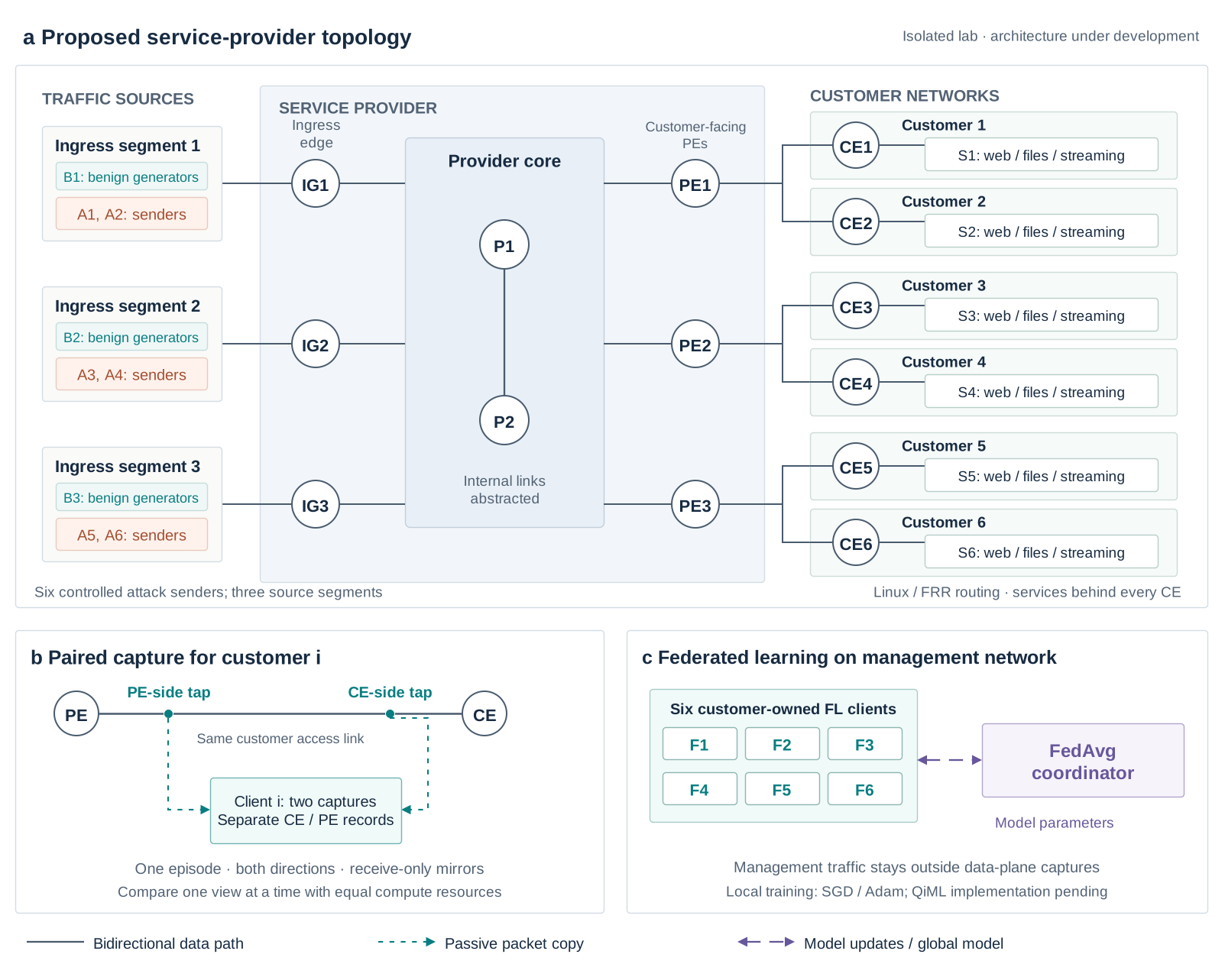
The figure is version 1, dated November 1, 2026. The PDF includes embedded fonts. Use a full-width landscape page for the combined figure and check label size before printing.
Project Record
| Part | Current status |
|---|---|
| Literature and references | 71 original substantive appraisal records and 16 later retained works, plus 8 targeted scholarly additions and 3 later acquired papers; 98 reading-bank works, 103 Zotero parent references |
| Research questions | Four working questions with distinct roles; final protocol and feasibility checks pending |
| Dataset preparation | Required source data and study feasibility remain to be verified |
| Baseline software | Version-2 benign-only pilot published after 43 passing unit tests and independent Gemini/Grok PASS reviews; real-data measurements remain from version 1 |
| QiML treatment | Optional fifth question, with bounded exploratory work in a dedicated chapter; numerical specification and implementation pending |
| Controlled laboratory study v2.1 | Design, topology and propositions frozen on November 15, 2026 and published unchanged; not built, no traffic generated, and each later step needs a separate release by the researcher |
| Main network lab | Separate finite ingress check and two-PoP native toy executed; continuous source-backed deployment, observation-policy, workload and scaling evaluation remain open |
| Thesis | English working draft under revision; bounded executions are recorded, with broader evaluation and human acceptance still open |
This page will connect published methods and results to the exact code, data provenance, and experiment records that support them. The code and lab page distinguishes available components from planned releases.