html`<style>
.prob-tool {
  border: 2px solid #ddd;
  border-radius: 8px;
  padding: 20px;
  margin: 1em 0;
  background: #fafafa;
  font-family: 'PT Sans', sans-serif;
}
.prob-tool .controls-row {
  display: flex;
  align-items: center;
  gap: 20px;
  flex-wrap: wrap;
  margin-bottom: 12px;
}
.prob-tool .controls-row label {
  font-weight: 600;
  margin-right: 6px;
}
.prob-tool .controls-row select,
.prob-tool .controls-row input[type="number"] {
  padding: 4px 10px;
  border: 1px solid #ccc;
  border-radius: 4px;
  font-size: 0.95em;
}
.prob-tool .btn-row {
  display: flex;
  align-items: center;
  gap: 10px;
  flex-wrap: wrap;
  margin-bottom: 16px;
}
.prob-tool .btn-row button {
  padding: 6px 16px;
  border: 1px solid #22176F;
  background: #fff;
  color: #22176F;
  border-radius: 4px;
  font-size: 0.9em;
  font-weight: 600;
  cursor: pointer;
  transition: background 0.2s, color 0.2s;
}
.prob-tool .btn-row button:hover {
  background: #22176F;
  color: #fff;
}
.prob-tool .icon-container {
  width: 56px;
  height: 56px;
  border: 2px solid #bbb;
  border-radius: 8px;
  display: flex;
  align-items: center;
  justify-content: center;
  background: #fff;
  margin-left: auto;
}
.prob-chart-area {
  border: 1px solid #ddd;
  border-radius: 6px;
  padding: 16px;
  margin: 12px 0;
  background: #fff;
}
.prob-table {
  width: 100%;
  border-collapse: collapse;
  margin-top: 1em;
  font-size: 0.92em;
}
.prob-table th {
  border-bottom: 2px solid #ccc;
  text-align: center;
  padding: 8px;
  font-weight: 700;
}
.prob-table th:first-child {
  text-align: left;
}
.prob-table td {
  border-bottom: 1px solid #eee;
  text-align: center;
  padding: 8px;
}
.prob-table td:first-child {
  text-align: left;
  font-weight: 600;
}
.prob-table tr.total-row {
  border-top: 2px solid #ccc;
  font-weight: 700;
}
</style>`Introduction to Probability
probability
Probability is a measure of how likely an event is to occur. If you throw a fair coin, the probability that it lands on heads is 50 percent (or ). If…
What is Probability?
Probability is a measure of how likely an event is to occur. If you throw a fair coin, the probability that it lands on heads is 50 percent (or \(\frac{1}{2}\)). If you throw a die, the probability of it landing on the number 4 is \(\frac{1}{6}\).
School Example
Imagine you are in a school with 10 kids and you want to randomly pick one child from the population. In this school, 3 kids play soccer and 7 do not.
The question is: what is the probability that the kid you picked at random plays soccer?
In math, we denote this as \(P(\text{soccer})\). To find it, we use the probability formula:
\[ P(\text{soccer}) = \frac{\overbrace{\text{Number of kids who play soccer}}^{\text{Event}}}{\underbrace{\text{Total number of kids}}_{\text{Sample Space}}} = \frac{3}{10} = 0.3 \]
So there is a 30 percent chance that a randomly selected kid plays soccer.
Key Terminology
Before moving forward, let us define some important terms.
- Experiment is any process that produces an outcome that is uncertain. Flipping a coin, rolling a die, or picking a random kid from a school are all experiments.
- Sample space is the set of all possible outcomes of an experiment. It represents 100 percent of the population.
- Event is a subset of the sample space. It contains the outcomes favorable to what we are looking for.
Venn Diagram Perspective
We can visualize probability using a Venn diagram. The total population (all children) is represented by a rectangle. This is the sample space. Inside it, a circle represents the event (kids who play soccer, 30 percent). The kids who do not play soccer are outside the circle but still inside the rectangle because they are part of the population.
We calculate probability by dividing the number of favorable outcomes (inside the circle) by the total number of possible outcomes (the entire rectangle).
\[ P(\text{event}) = \frac{\text{Number of favorable outcomes}}{\text{Total number of possible outcomes}} \]
Coin Flip Experiments
Single Coin
When we flip a fair coin, it can land on heads or tails. Because the outcome is uncertain, flipping a coin is an experiment. Since the coin is fair, each outcome is equally likely.
\[ P(\text{heads}) = \frac{\text{Event of landing on heads}}{\text{Total number of outcomes}} = \frac{1}{2} = 0.5 \]
Two Coins
What is the probability of both coins landing on heads? Let us list all possible outcomes by considering what can happen with each coin:
| First Coin | Second Coin | Outcome |
|---|---|---|
| H | H | HH |
| H | T | HT |
| T | H | TH |
| T | T | TT |
There are 4 total outcomes. Only one of them (HH) is the event we are interested in.
\[ P(HH) = \frac{1}{4} = 0.25 \]
Three Coins
With three coins, the total number of outcomes doubles again. The third coin can land on heads or tails for each of the four outcomes from the first two coins, giving us \(2 \times 4 = 8\) total outcomes:
HHH, HHT, HTH, HTT, THH, THT, TTH, TTT
Out of these 8 possible outcomes, only one is all heads (HHH).
\[ P(HHH) = \frac{1}{8} = 0.125 \]
NotePattern
Notice the pattern. With 1 coin the probability of all heads is \(\frac{1}{2}\), with 2 coins it is \(\frac{1}{4}\), and with 3 coins it is \(\frac{1}{8}\). In general, the probability of getting all heads with \(n\) fair coins is \(\frac{1}{2^n}\).
Dice Experiments
Single Die
Let us reinforce the concept of probability using the experiment of rolling a fair six-sided die. What is the probability of obtaining a 6?
Six outcomes are possible and all of them are equally likely. That is the sample space (size 6). Only one of these outcomes is favorable (rolling a 6). That is the event (size 1).
\[ P(6) = \frac{1}{6} \]
Two Dice
What if we roll two dice? What is the probability of obtaining 6 on both?
For each of the 6 possibilities on the first die, there are 6 possibilities on the second die. That gives us \(6 \times 6 = 36\) total outcomes in the sample space:
(1,1), (1,2), (1,3), …, (6,4), (6,5), (6,6)
Only one outcome is favorable: (6,6).
\[ P(6,6) = \frac{1}{36} \]
NotePattern
Similar to coins, rolling \(n\) dice and asking for a specific outcome on all of them gives a probability of \(\frac{1}{6^n}\).
Empirical Probability
As you flip a coin or roll a die many times, the frequency of each outcome approaches the theoretical probability. For example, if you flip a coin 10 times you might get 7 heads, but if you flip it 10,000 times the proportion of heads will be very close to 0.5. This idea, that experimental results converge to theoretical probability with more trials, is known as the Law of Large Numbers.
Try the interactive tool below to see this in action.
Review Questions
1. A bag contains 5 red marbles and 15 blue marbles. If you pick one marble at random, what is the probability of picking a red marble?
TipAnswer
\(P(\text{red}) = \frac{5}{20} = \frac{1}{4} = 0.25\). There are 5 favorable outcomes (red marbles) out of 20 total possible outcomes.
1. You flip 4 fair coins. What is the probability that all four land on heads?
TipAnswer
\(P(HHHH) = \frac{1}{2^4} = \frac{1}{16} = 0.0625\). There are \(2^4 = 16\) total outcomes and only one of them is all heads.
1. What is the difference between the sample space and an event?
TipAnswer
The sample space is the set of all possible outcomes of an experiment. An event is a subset of the sample space that contains only the outcomes we are interested in (the favorable outcomes).
Complement of an Event
The complement of an event is the probability that the event does not occur. If an event has a probability of 75%, then the complement (the event not occurring) has a probability of 25%.
Soccer Example Revisited
Let us go back to the school with 10 kids, where 3 play soccer and 7 do not. What is the probability that a randomly picked child does not play soccer?
We denote this as \(P(\text{not soccer})\). Using the same approach as before, we count the kids who do not play soccer and divide by the total:
\[ P(\text{not soccer}) = \frac{7}{10} = 0.7 \]
Notice that \(P(\text{soccer}) = 0.3\) and \(P(\text{not soccer}) = 0.7\), and they add up to 1. This always happens.
Complement Rule
We can rewrite \(P(\text{not soccer})\) as \(1 - 0.3 = 0.7\). This is the complement rule:
\[ P(A') = 1 - P(A) \]
where \(A'\) represents the complement of event \(A\) (when \(A\) does not happen).
Using this formula, we can calculate the probability of an event not happening in a more straightforward manner rather than counting unfavorable outcomes directly.
Coin Example
Using the experiment of flipping three coins, what is the probability of not obtaining three heads?
By the complement rule:
\[ P(\text{not three heads}) = 1 - P(\text{three heads}) = 1 - \frac{1}{8} = \frac{7}{8} \]
You can also see it as 7 favorable cases (everything except HHH) divided by 8 total outcomes.
Dice Example
If you throw one die, what is the probability of obtaining anything different than 6?
\[ P(\text{not } 6) = 1 - P(6) = \frac{6}{6} - \frac{1}{6} = \frac{5}{6} \]
There are 6 possible outcomes. We remove the one that is landing on 6, leaving 5 favorable outcomes out of 6.
Review Questions
1. A jar contains 8 green balls and 2 yellow balls. What is the probability of NOT picking a green ball?
TipAnswer
\(P(\text{not green}) = 1 - P(\text{green}) = 1 - \frac{8}{10} = \frac{2}{10} = 0.2\)
1. You roll two dice. What is the probability of NOT getting (6,6)?
TipAnswer
\(P(\text{not } (6,6)) = 1 - P(6,6) = 1 - \frac{1}{36} = \frac{35}{36}\)
1. If \(P(A) = 0.85\), what is \(P(A')\)?
TipAnswer
\(P(A') = 1 - P(A) = 1 - 0.85 = 0.15\)
Sum of Probabilities (Disjoint Events)
If you know the probability of getting a 2 on a die and the probability of getting a 3, and you want the probability of getting a 2 or a 3, you simply add the probabilities. However, there is a caveat. This only works when the events are disjoint (they cannot both happen at the same time).
School Example with Two Sports
Consider a school where kids can only play one sport (this is important). The sport can be soccer or basketball.
- \(P(\text{soccer}) = 0.3\)
- \(P(\text{basketball}) = 0.4\)
What is the probability that a kid plays soccer or basketball?
Since kids can only play one sport, these events are disjoint. Imagine there are 10 kids. Then 3 play soccer and 4 play basketball. The number of kids who play soccer or basketball is \(3 + 4 = 7\).
\[ P(\text{soccer or basketball}) = \frac{3 + 4}{10} = 0.7 \]
Notice we simply added the individual probabilities: \(0.3 + 0.4 = 0.7\).
Addition Rule for Disjoint Events
In set notation, “or” is represented by the union symbol \(\cup\). If events \(A\) and \(B\) are disjoint (they share no outcomes), then:
\[ P(A \cup B) = P(A) + P(B) \]
The Venn diagram below shows two disjoint events \(A\) (soccer) and \(B\) (basketball) with no overlap, meaning no child plays both sports. The union \(A \cup B\) is the combined area of both circles.
The green rectangle is the sample space (all children). The two circles represent disjoint events: Soccer (30%) and Basketball (40%). Because the circles do not overlap, we can simply add the probabilities to get \(P(A \cup B)\).
Single Die Example
Roll a fair six-sided die once. What is the probability of obtaining an even number or a 5?
- Event \(A\): rolling an even number (2, 4, 6) — that is 3 outcomes
- Event \(B\): rolling a 5 — that is 1 outcome
These events are disjoint (5 is not even), so we add:
\[ P(A \cup B) = \frac{3}{6} + \frac{1}{6} = \frac{4}{6} = \frac{2}{3} \]
Two Dice Example: Sum of 7 or Sum of 10
Roll two dice. What is the probability of obtaining a sum of 7 or a sum of 10?
Out of 36 total outcomes:
- Event \(A\) (sum of 7): (1,6), (2,5), (3,4), (4,3), (5,2), (6,1) — 6 outcomes
- Event \(B\) (sum of 10): (4,6), (5,5), (6,4) — 3 outcomes
The grid below shows all 36 outcomes when rolling two dice. Yellow cells are pairs that sum to 7 (event \(A\)), green cells sum to 10 (event \(B\)). Since no pair can sum to both, these events are disjoint.
These events are disjoint (no pair can sum to both 7 and 10), so:
\[ P(A \cup B) = \frac{6}{36} + \frac{3}{36} = \frac{9}{36} = \frac{1}{4} \]
Two Dice Example: Difference of 2 or Difference of 1
What is the probability of obtaining a difference of 2 or a difference of 1?
The difference can go in either direction (first minus second, or second minus first).
- Event \(A\) (difference of 2): (1,3), (2,4), (3,5), (4,6), (3,1), (4,2), (5,3), (6,4) — 8 outcomes
- Event \(B\) (difference of 1): (1,2), (2,3), (3,4), (4,5), (5,6), (2,1), (3,2), (4,3), (5,4), (6,5) — 10 outcomes
These events are disjoint (a pair cannot have a difference of both 1 and 2), so:
\[ P(A \cup B) = \frac{8}{36} + \frac{10}{36} = \frac{18}{36} = \frac{1}{2} \]
That is a 50% chance of rolling a difference of 1 or 2.
Review Questions
1. You roll a fair die. What is the probability of getting a 1 or a 6?
TipAnswer
These are disjoint events. \(P(1 \cup 6) = \frac{1}{6} + \frac{1}{6} = \frac{2}{6} = \frac{1}{3}\)
1. In a class of 20 students, 5 study French and 8 study Spanish. No student studies both. What is the probability a randomly chosen student studies French or Spanish?
TipAnswer
\(P(\text{French} \cup \text{Spanish}) = \frac{5}{20} + \frac{8}{20} = \frac{13}{20} = 0.65\)
1. Why does the addition rule \(P(A \cup B) = P(A) + P(B)\) only work for disjoint events?
TipAnswer
If events overlap (share outcomes), adding their probabilities would count the shared outcomes twice. The events must be disjoint (mutually exclusive) so that no outcome is counted more than once.
Sum of Probabilities (Joint Events)
What happens when events are not disjoint? Consider this: the probability of rain is 80% and the probability of wind is 70%. If you add them you get 150%, which is impossible. The problem is that rain and wind can happen at the same time. When events overlap, we cannot simply add their probabilities.
School Example with Overlapping Sports
We return to the school, but now kids can play as many sports as they want. The options are still soccer and basketball.
- \(P(\text{soccer}) = 0.6\)
- \(P(\text{basketball}) = 0.5\)
What is the probability that a kid plays soccer or basketball?
If we try to add \(0.6 + 0.5 = 1.1\), that is more than 100%, which is impossible. We are over-counting the kids who play both sports. That overlap is the intersection: \(P(S \cap B)\).
Inclusion-Exclusion Principle
To solve this, we need to know how many kids play both. Suppose there are 10 kids: 6 play soccer, 5 play basketball, and 3 play both.
The Venn diagram below shows the two overlapping circles. The soccer circle contains 6 kids, the basketball circle contains 5, and the overlap (intersection) contains the 3 who play both. The two X marks at the bottom represent the 2 kids who play neither sport.
How many play soccer or basketball (or both)?
\[ |S \cup B| = |S| + |B| - |S \cap B| = 6 + 5 - 3 = 8 \]
The 3 kids who play both were counted once in the soccer group and once in the basketball group, so we subtract them to avoid double-counting. This is the inclusion-exclusion principle.
General Addition Rule
The same logic works with probabilities:
\[ P(A \cup B) = P(A) + P(B) - P(A \cap B) \]
Using our example:
\[ P(S \cup B) = 0.6 + 0.5 - 0.3 = 0.8 \]
NoteDisjoint is a Special Case
When events are disjoint, \(P(A \cap B) = 0\) (they never happen together). The general formula reduces to \(P(A \cup B) = P(A) + P(B)\), which is the simpler rule we saw earlier. The general formula always works, whether events overlap or not.
The diagram below summarizes both cases. On the left, disjoint events have no overlap and their union probability is simply the sum. On the right, joint events overlap, so the intersection must be subtracted.
Two Dice Example: Sum of 7 or Difference of 1
What is the probability of obtaining a sum of 7 or a difference of 1?
- Event \(A\) (sum of 7): (1,6), (2,5), (3,4), (4,3), (5,2), (6,1) — 6 outcomes
- Event \(B\) (difference of 1): (1,2), (2,1), (2,3), (3,2), (3,4), (4,3), (4,5), (5,4), (5,6), (6,5) — 10 outcomes
These events are not disjoint. The pairs (3,4) and (4,3) both sum to 7 and have a difference of 1. That is 2 outcomes in the intersection.
\[ P(A \cup B) = \frac{6}{36} + \frac{10}{36} - \frac{2}{36} = \frac{14}{36} = \frac{7}{18} \]
Review Questions
1. Events \(A\) and \(B\) have \(P(A) = 0.4\), \(P(B) = 0.5\), and \(P(A \cap B) = 0.2\). What is \(P(A \cup B)\)?
TipAnswer
\(P(A \cup B) = 0.4 + 0.5 - 0.2 = 0.7\)
1. In a class of 30 students, 18 like math, 15 like science, and 10 like both. What is the probability a random student likes math or science?
TipAnswer
\(P(M \cup S) = \frac{18}{30} + \frac{15}{30} - \frac{10}{30} = \frac{23}{30} \approx 0.767\)
1. If \(P(A \cup B) = 0.9\), \(P(A) = 0.6\), and \(P(B) = 0.5\), what is \(P(A \cap B)\)?
TipAnswer
Rearranging the formula: \(P(A \cap B) = P(A) + P(B) - P(A \cup B) = 0.6 + 0.5 - 0.9 = 0.2\)
Independence and Product Rule
Two events are independent when the occurrence of one does not affect the probability of the other. For example, if you toss a coin twice, the result of the first toss does not affect the second. On the other hand, in a chess game, what happens on the 10th move affects the 11th move, so those events are not independent.
Understanding independence is important in machine learning because assuming independence simplifies calculations and helps make predictions.
School Example: Rooms
Consider a school with 100 kids where 40 like soccer (\(P(\text{soccer}) = 0.4\)) and 60 do not. The kids are randomly split into two rooms: room 1 holds 30 kids (\(P(R_1) = 0.3\)) and room 2 holds 70.
What is the probability that a randomly chosen kid plays soccer and is in room 1?
Since the room assignment is random and has nothing to do with sports preference, these events are independent. We expect 40% of each room to like soccer. In room 1 that is \(0.4 \times 30 = 12\) kids, or 12% of the total.
\[ P(\text{soccer} \cap R_1) = P(\text{soccer}) \times P(R_1) = 0.4 \times 0.3 = 0.12 \]
Product Rule for Independent Events
When events \(A\) and \(B\) are independent:
\[ P(A \cap B) = P(A) \times P(B) \]
This extends to any number of independent events. If \(A_1, A_2, \ldots, A_n\) are all independent:
\[ P(A_1 \cap A_2 \cap \cdots \cap A_n) = P(A_1) \times P(A_2) \times \cdots \times P(A_n) \]
Coin Example
What is the probability that a fair coin lands on heads all 5 times? Each toss is independent.
\[ P(HHHHH) = \left(\frac{1}{2}\right)^5 = \frac{1}{32} \]
Dice Example
What is the probability of rolling a 6 on two independent dice?
\[ P(6,6) = \frac{1}{6} \times \frac{1}{6} = \frac{1}{36} \]
What about rolling ten sixes on ten independent dice?
\[ P(\text{ten sixes}) = \left(\frac{1}{6}\right)^{10} \approx 0.0000000165 \]
A very small number, but the calculation is straightforward thanks to the product rule.
Review Questions
1. You flip a fair coin 3 times and roll a fair die once. What is the probability of getting HHH and rolling a 4?
TipAnswer
These are independent events. \(P(HHH) \times P(4) = \frac{1}{8} \times \frac{1}{6} = \frac{1}{48}\)
1. Are the following events independent? Drawing a card from a deck, not replacing it, then drawing another card.
TipAnswer
No. The first draw changes the composition of the deck, so the probability of the second draw is affected by the first. These events are dependent.
1. If \(P(A) = 0.7\) and \(P(B) = 0.3\), and \(A\) and \(B\) are independent, what is \(P(A \cap B)\)?
TipAnswer
\(P(A \cap B) = 0.7 \times 0.3 = 0.21\)
Birthday Problem
One of the most fascinating problems in probability. Imagine you are at a party with 30 friends. What is more likely: that two people share a birthday, or that all 30 have different birthdays?
Assume the year has 365 days (no leap year). The answer is surprising: with 30 people, there is about a 70% chance that at least two share a birthday.
Computing the Probability
It is easier to compute the complement: the probability that no two people share a birthday. Then we subtract from 1.
We build up person by person. Each new person must have a birthday on a day not already taken:
- 1 person: \(\frac{365}{365} = 1\)
- 2 people: \(\frac{365}{365} \times \frac{364}{365}\)
- 3 people: \(\frac{365}{365} \times \frac{364}{365} \times \frac{363}{365}\)
- \(n\) people: \(\frac{365}{365} \times \frac{364}{365} \times \frac{363}{365} \times \cdots \times \frac{365 - n + 1}{365}\)
For 9 people this product is approximately 0.905 (90% chance all birthdays are different).
Key Values
| People | \(P(\text{all different})\) |
|---|---|
| 1 | 1 |
| 2 | 0.997 |
| 3 | 0.992 |
| 4 | 0.984 |
| 5 | 0.973 |
| 10 | 0.883 |
| 20 | 0.589 |
| 23 | 0.493 |
| 30 | 0.294 |
| 50 | 0.030 |
| 100 | 0.0000003 |
| 366 | 0 |
At 23 people, the probability crosses 50%. If you are ever at a party with 23 people, you can bet that there is a repeated birthday and you would win more than half of the time.
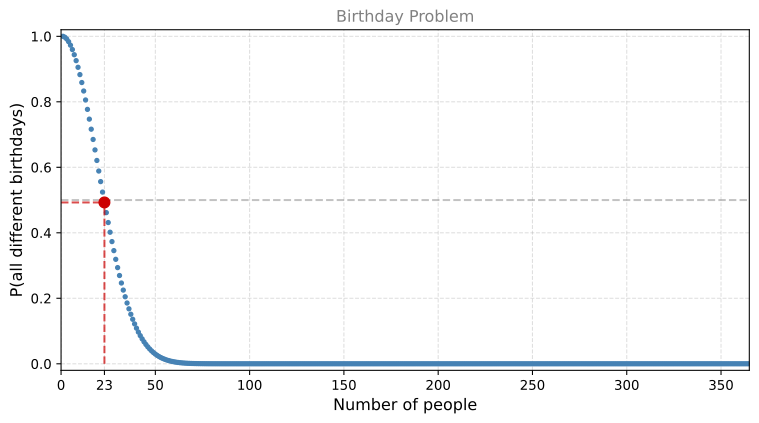
Try the interactive version below. Drag the slider to see how the probability changes as you add people to the room.
NoteWhy 23?
It feels non-intuitive because we think about one specific person matching another. But with 23 people there are \(\binom{23}{2} = 253\) possible pairs, and each pair has a \(\frac{1}{365}\) chance of matching. Those chances accumulate quickly.
Review Questions
1. In a group of 50 people, is it more likely that two share a birthday or that all birthdays are unique?
TipAnswer
It is overwhelmingly more likely that two share a birthday. The probability of all unique birthdays with 50 people is only about 3%.
1. Why do we compute \(P(\text{no match})\) first instead of \(P(\text{at least one match})\) directly?
TipAnswer
Computing “at least one match” directly requires considering many overlapping cases (person 1 matches 2, or 1 matches 3, or 2 matches 5, etc.). The complement “no one matches” is a single chain of independent multiplications, which is much simpler.
1. You flip a fair coin two times. What is the probability of getting one head and one tail in any order?
TipAnswer
The sample space is {HH, HT, TH, TT}. Favorable outcomes for one head and one tail: HT, TH = 2 out of 4. So \(P = \frac{2}{4} = \frac{1}{2}\).
1. You throw two dice and sum the result. What is the probability the sum is equal to 10?
TipAnswer
Favorable pairs: (4,6), (5,5), (6,4) = 3 outcomes out of 36 total. So \(P = \frac{3}{36} = \frac{1}{12}\).
1. You throw a six-sided die 10 times, summing the result in each throw. What is the probability that the sum of results is greater than 10? (Hint: use the complement rule)
TipAnswer
The minimum possible sum is 10 (rolling 1 every time). The only way to get a sum of exactly 10 is to roll all ones. \(P(\text{all ones}) = \left(\frac{1}{6}\right)^{10} = \frac{1}{6^{10}}\). By the complement rule: \(P(\text{sum} > 10) = 1 - \frac{1}{6^{10}} = \frac{6^{10} - 1}{6^{10}}\).
1. In an experiment, there are 100 patients. After taking medicine, 50 experienced a headache and 50 experienced a fever. What is the probability that a patient may experience a headache or fever?
TipAnswer
Not enough information is given. We do not know how many patients experienced both headache and fever (the overlap). Without knowing \(P(\text{headache} \cap \text{fever})\), we cannot compute \(P(\text{headache} \cup \text{fever}) = P(\text{headache}) + P(\text{fever}) - P(\text{headache} \cap \text{fever})\). Some patients may have had both symptoms.
1. In a bag of marbles, there are two disjoint events: \(A\) represents selecting a red marble, and \(B\) represents selecting a blue marble. The probability of selecting a red marble is \(P(A) = \frac{1}{4}\), and the probability of selecting a blue marble is \(P(B) = \frac{1}{3}\). What is \(P(A \cup B)\)?
- \(\frac{7}{12}\)
- \(\frac{2}{3}\)
- \(\frac{1}{12}\)
- \(\frac{5}{12}\)
TipAnswer
a. \(P(A \cup B) = \frac{7}{12}\). Since \(A\) and \(B\) are disjoint (a marble cannot be both red and blue), \(P(A \cup B) = P(A) + P(B) = \frac{1}{4} + \frac{1}{3} = \frac{3}{12} + \frac{4}{12} = \frac{7}{12}\).
1. You throw 10 fair coins. What is the probability that the coins do not result in all heads?
- \(\frac{1}{10^2}\)
- \(\frac{1}{2^{10}}\)
- \(\frac{10^2 - 1}{10^2}\)
- \(\frac{2^{10} - 1}{2^{10}}\)
TipAnswer
d. \(\frac{2^{10} - 1}{2^{10}}\). The probability of all heads is \(\left(\frac{1}{2}\right)^{10} = \frac{1}{2^{10}}\). By the complement rule, the probability of NOT all heads is \(1 - \frac{1}{2^{10}} = \frac{2^{10} - 1}{2^{10}}\).